
A common benchmark that gives investors confidence risk is being addressed
The Standards set out how a project can become peace-aligned by using a small share of its investment to include peace measures, designed to reduce conflict risks, and enhance its positive impact on communities.
What we mean by conflict risk
Conflict risks are defined as risks that can lead to non-violent and violent conflicts, driven by a range of factors, including political, social and environmental factors, and that potentially can undermine a project’s viability, profitability and outcomes.
The Standards group these risks into seven areas:
- Land and resource disputes
- Exclusion and inequality
- Governance and corruption
- Security and violence
- Environmental and livelihood impacts
- Political and regulatory factors
- Community tensions

What certification confirms
Certification signals that a project is aligned with the Standards. It is reviewed every year by an independent verifier.
The right parties are in place
An accountable project owner, a peace expert approved by Finance for Peace, and an independent verifier.
The project is eligible
The project is described in full and passes the exclusion criteria in the Standards.
The conflict risks are assessed
A context analysis identifies local conflict drivers, key actors and how the project affects them.
A funded Peace Plan answers those risks
Each peace measure responds to an identified risk and has a budget, timeline and indicators to track it.
Monitoring and reporting are assigned
An independent complaints mechanism is in place, and a verified Annual Peace Impact Report is published.
The Standards are still met every year
The verifier reviews delivery each year, and the Standards Committee renews certification, requires remediation or withdraws it.
Read the Standards
The full Standards and certification process, with the application form, a worked example and the terms of reference for peace experts and independent verifiers.
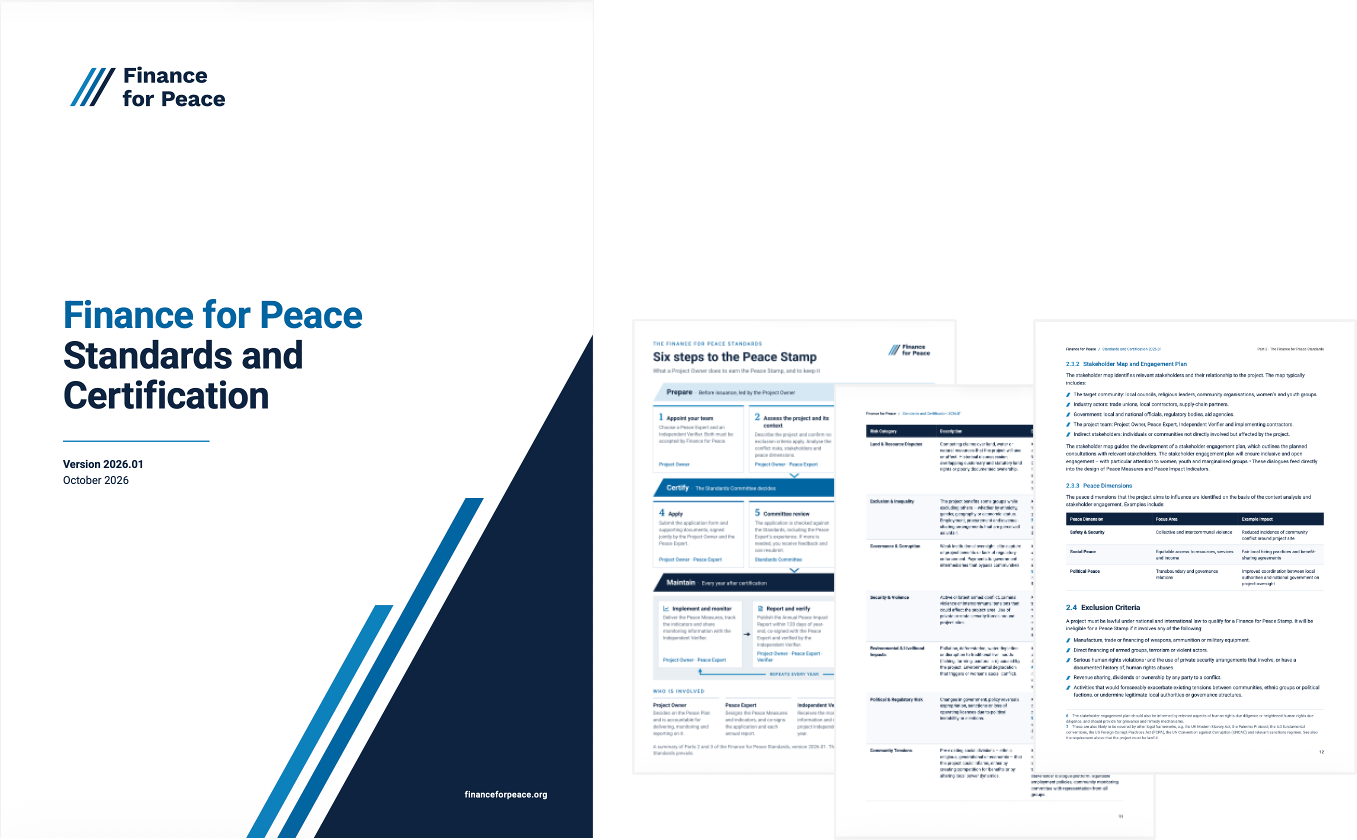
Finance for Peace Standards & Certification
Version 2026.01, approved by the Standards Committee. PDF, 40 pages, 0.3 MB.
Frequently asked questions
Questions project owners, issuers and investors ask about the Standards and how certification works.
What is the difference between ESG, impact investing and peace-aligned investing?
The key difference is that peace-aligned investing incorporates peace measures to reduce conflict risk, which can improve the return risk profile and may lower the cost of capital, while also having a peace impact on the community.
Both ESG and impact investing refer to what type of projects or activities the funding is used for. Peace-aligned investing is different, as it focuses on how the projects or activities are implemented.
ESG can be seen as a screening and reporting framework, while impact investing targets a specific environmental or social objective that is treated as separate from the financial objective. The Standards complement existing ESG analysis and responsible investment approaches by providing a specific framework for peace measures and independent verification.
Peace-aligned investing works differently: it can be added to virtually any project and can even be seen as expanding the investable opportunity set by reducing risk. It is also directly linked to the financial objective, since the risk reduction improves the project’s return risk profile, making it a commercially more attractive investment.
How is a peace certification different from a green or social bond?
Green and social bond frameworks focus on eligible uses of proceeds and associated processes and reporting. Peace certification adds a specific assessment of conflict context, peacebuilding measures and compliance with the Finance for Peace Standards.
What asset classes and financial structures do the Standards apply to?
The Finance for Peace Standards cover all asset classes, including fixed income and equities, and a wide range of financial instruments, including bonds, loans, equities and blended structures, both in public and private markets.
If the application for a Finance for Peace certification is for a financial instrument linked to the overall company activity, the application and subsequent monitoring have to cover all the company activities. If the application is for one or more specific projects, the application only has to cover those projects.
We already do ESIA, human rights due diligence and stakeholder engagement. What does this add?
The Finance for Peace Standards are designed to build on and extend existing frameworks and processes, applying them in a new way. The context analysis within the Finance for Peace Standards is similar to environmental impact assessment, and existing ESIA, FPIC and engagement records can form part of the application evidence. However, comprehensive reviews of existing ESIA, human rights due diligence and ESG frameworks have found that they tend to miss conflict risks that often drive the grievances determining whether a project keeps its “social licence”. What the Finance for Peace framework adds is the piece conventional due diligence typically lacks: the explicit analysis of conflict risks and their drivers; the inclusion of bespoke, funded peace measures to reduce conflict risks; the monitoring and evaluation of these measures; and independent verification of the progress – all available to the market to impact the pricing of risk.
What happens if a project stops complying with the Standards?
Non-compliance means failing to implement the Peace Plan as committed – e.g. peace measures not delivered, budgets not spent as agreed, reporting missed or misrepresented, or the complaints mechanism allowed to lapse. It does not mean failing to achieve all the peace outcomes. Note that if over time there are material changes in circumstances, the Peace Plan can be enhanced and a revised version submitted to the Standards Committee.
The annual review covers whether the project owner and peace expert continue to deliver against the plans set out in the application; whether there have been any changes to the peace measures or peace impact indicators and, if so, the rationale for those changes; and whether the independent complaints mechanism is in place and functioning. This review will be verified by the independent verifier.
Community and beneficiary feedback from the complaint mechanism is also reviewed as part of the annual cycle, driving project adjustments and being reported to investors.
If the Standards are met, certification is renewed and this is publicly confirmed. If adjustments are needed to implement the Peace Plan as committed, the Standards Committee sets specific remediation requirements within a defined timeframe; certification is retained if these are resolved and withdrawn if not. For major non-compliance, corrective action is required within a set timeframe – failure to comply leads to withdrawal of certification.
Transparency is a core principle: all decisions on renewal, remediation, and withdrawal are documented and disclosed.
If certification is withdrawn, it signals that the project’s conflict-risk management is no longer meeting what is required in the Standards and that the risk profile of the investment may have increased.
What is a certified project accountable for – process or final outcomes?
A peace-aligned project with Finance for Peace certification is accountable for the implementation of the project, not the outcome. The core accountability is that the commitments in the application submitted to the Standards Committee are implemented by the project owner. This means the proposed measures are delivered as described, data is collected and reported, and the complaints mechanism is kept functioning. In short, you are held to what you said you were going to do – not to the outcomes of what you did.
The accountability for outcomes is deliberately outside the scope of certification. Peace outcomes in complex social environments are shaped by forces well beyond any single project’s control, and no project will be penalised for failing to produce peace results that even a dedicated peacebuilding effort cannot guarantee. That said, outcomes are far from ignored: peace impact indicators are measured, verified and published because the Standards Committee wants to help investors and project owners improve their approaches, further reduce risks, and – where possible – disseminate what works in de-risking to the wider market. Outcome data drive learning and adaptation; implementation drives certification.
What is the risk of “peace washing”?
There are several parts of the Finance for Peace certification process that help guard against “peace washing”: an independent Standards Committee makes the certification decision rather than relying on self-labelling; a required, funded Peace Plan sets out an explicit risk-reduction logic rather than aspirational commitments; annual reporting is independently verified; a mandatory complaints mechanism operates independently of the project owner; and the application, annual report and committee actions – including any withdrawal – are publicly disclosed.
There is also less incentive to “wash” – to pretend to do something that is not being done – when properly implemented peace measures are likely to lead to risk reduction, improving the viability and commercial attractiveness of the project.
Do you certify asset managers and funds?
We will also certify funds managed by financial advisers or asset managers. However, the principle for doing this will be a “look-through”, with a focus on the underlying company or project investments. If all the investments or projects are peace-aligned, the fund can be certified. This certification can be retained as long as new investments also meet the Standards.
Do your funders buy your Standards?
They do not. The Standards are set by an independent Standards Committee, kept apart from fundraising and partnerships. Funders and what they fund are published. No funder or partner shapes, approves or funds the content of the Standards.
What is a Peace Bond?
A Peace Bond is a bond whose financed activities meet the Finance for Peace Standards. It combines conventional bond financing with measures designed to address conflict-related risks and support peace. Investors assess the issuer’s creditworthiness and the bond’s terms alongside its peace certification.